Peter Boos’ incredible journey with the Substance Abuse Foundation (SAF) has spanned a quarter of a century. He was instrumental in its creation, critical to its development and passionate about its success. Although Peter relinquished his Chairman’s role at the end of 2020, his name remains synonymous with the SAF. His multiple roles have included…
by Kristina Evelyn | Sep 5, 2021 | Canine Cancer Blog Written for the National Canine Cancer Foundation Choosing that perfect pet to join the family is a highly personal decision. Owners choose particular dogs for a variety of reasons, varying from practical to nonsensical! For some, if ever there was a time to reap the benefits of owning a…
Peter Boos’ incredible journey with the Substance Abuse Foundation (SAF) has spanned a quarter of a century. He was instrumental in its creation, critical to its development and passionate about its success. Although Peter relinquished his Chairman’s role at the end of 2020, his name remains synonymous with the SAF. His multiple roles have included founding member, CEO and board member before his five-year Chairmanship.
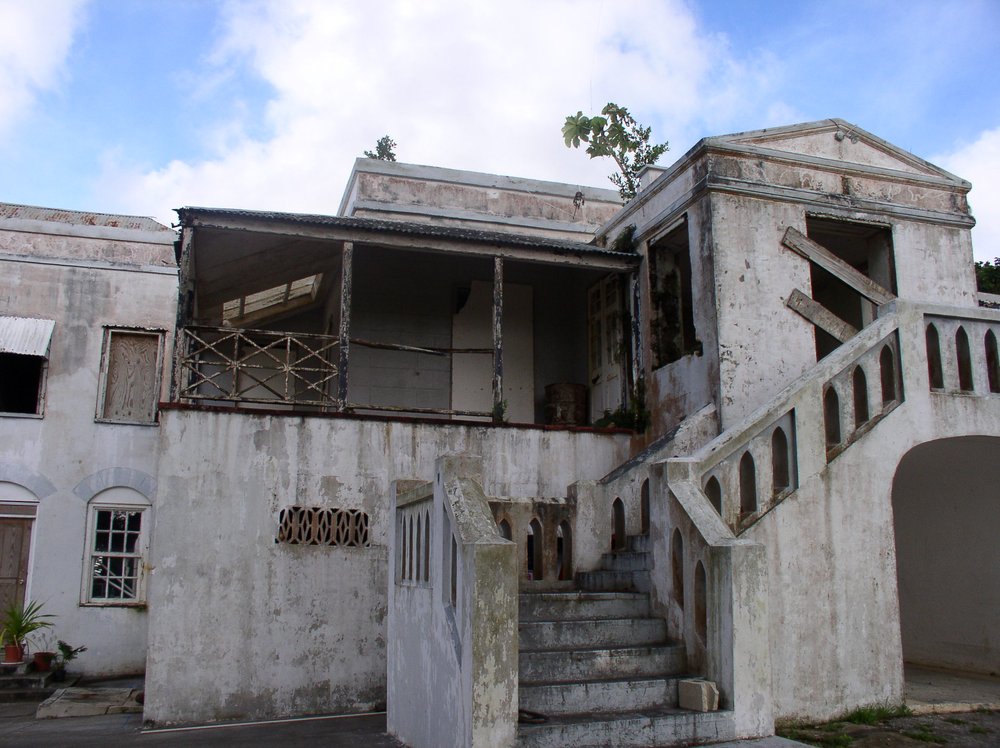
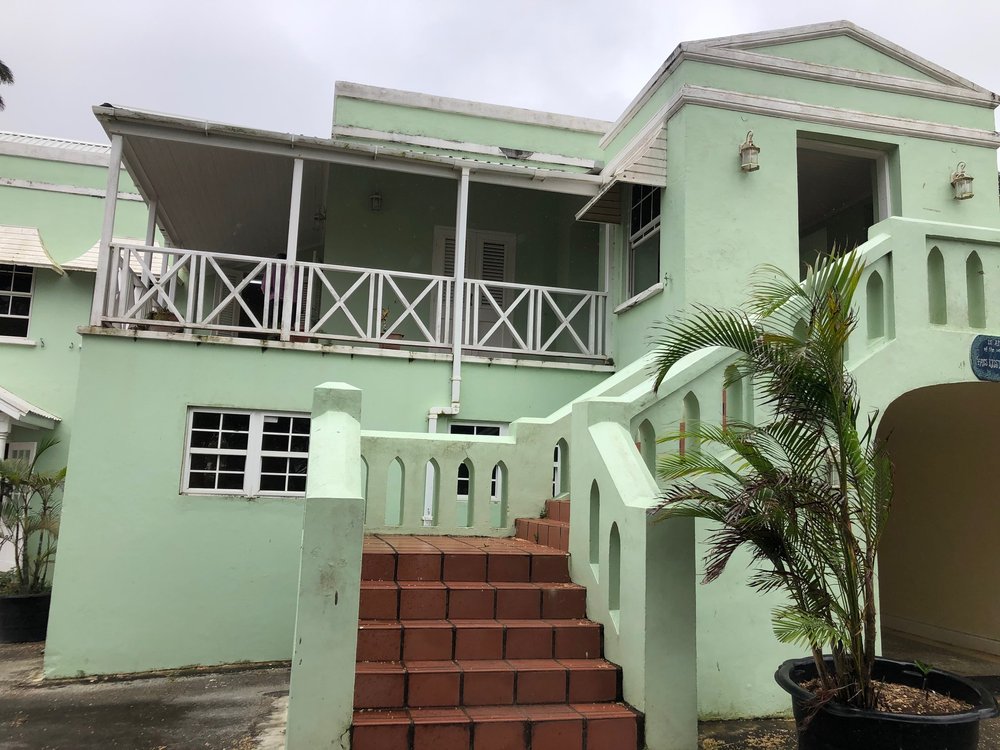
It’s difficult to capture in words the enormity of Peter’s contribution to the SAF, Verdun and Marina Houses, the clients they have served and, by extension, the Barbadian society. Peter saw an extreme need and put his heart and soul into providing a revolutionary solution. He feels an inordinate sense of achievement for each person who has recovered. His vision was vital to transforming SAF Inc from a non-profit organisation to the first social enterprise in the Caribbean and is a significant step towards SAF’s financial sustainability.
The Early Days
Twenty-five years ago, a group of Barbadians, whose lives had been touched by the devastating effects of drug abuse, formed an informal group to support each other. Out of this adversity came Verdun House, an internationally respected treatment facility that brought hope to those suffering from addiction’s chronic, complex disease. The significant, ground-breaking actions of this group have saved hundreds of Barbadian lives. Peter Boos was a part of SAF from the very beginning when it was just an idea.
It was a massive undertaking in the early days. A suitable location was identified, and then the group had to obtain funding. The property required significant renovations. There were local government regulations and international standards to be met; staff had to be hired and there were many other details. Verdun House, a residential addiction facility serving adult males, opened its doors in October 2000. It was indeed a ground-breaking feat.
Peter is quick to acknowledge that Verdun House would not exist without the Julia & Hans Rausing Trust. “They underpinned the entire project. They have stayed the course.” He is extremely grateful to them for contributing to the annual operating costs for more than 20 years.
2004-2015
Peter had an outstanding business career. As a leader, he was liked and respected by staff members at every level. His overriding concern for the staff’s welfare was well-known. After retirement from the post of Executive Chairman of Ernst & Young Caribbean in 2004, Peter offered to augment the management at Verdun House. As a part-time, unpaid, supervising CEO at Verdun, he brought unparalleled business expertise and his trademark compassion to SAF for eleven years. Says fellow founding member Norman Barrow, “Peter Boos moved Verdun to a different level during his tenure as CEO.” Norman credits Peter with establishing SAF as an efficiently run organisation, with proper financial records that gave benefactors confidence.
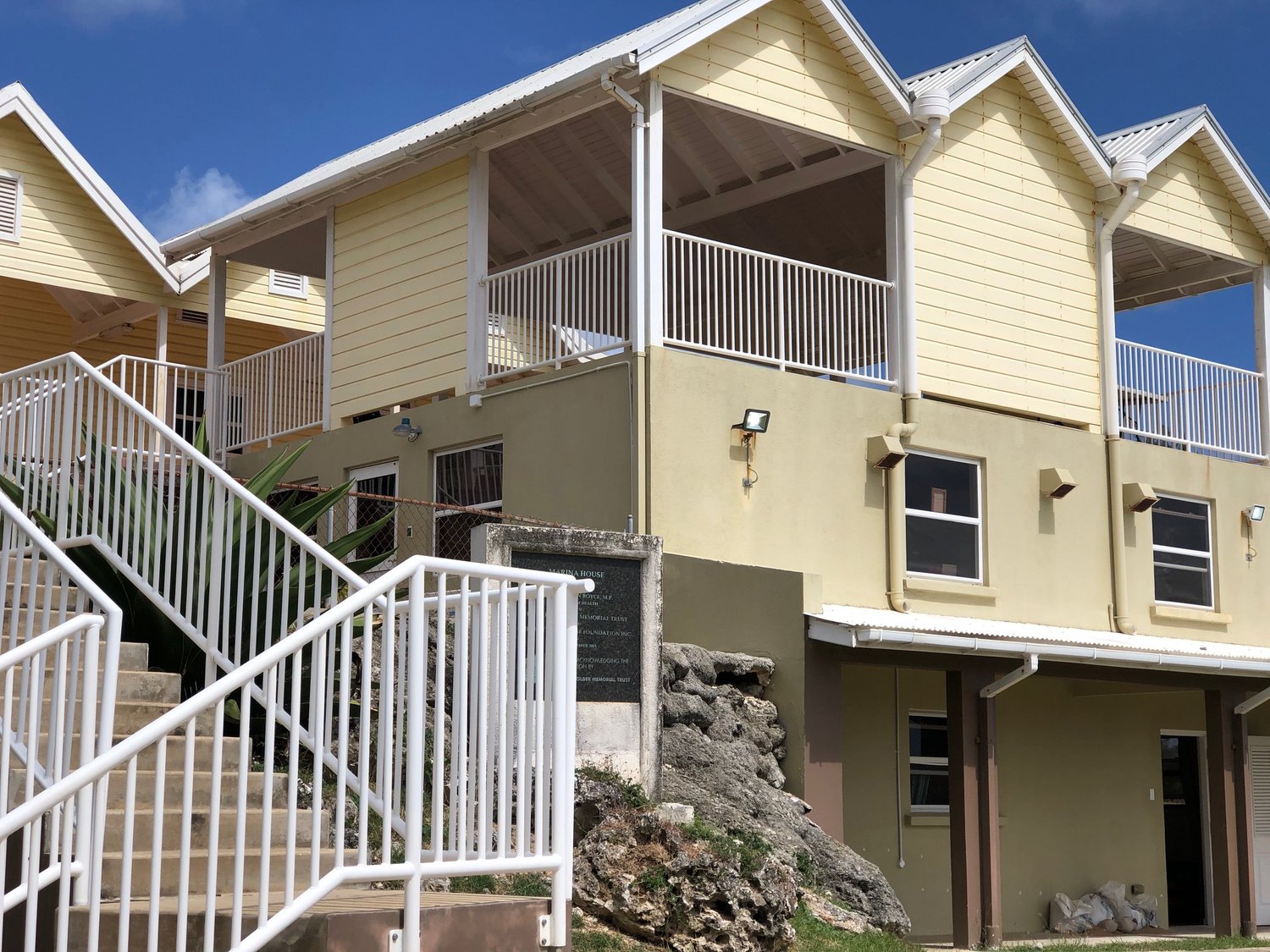
Peter stepped down from volunteer part-time CEO in 2015 to make way for the engagement of a full-time paid CEO. He was immediately appointed SAF Chairman. Later that year, Marina House was opened by the SAF for women recovering from addiction. This opening was a momentous occasion in the SAF’s history and a win for the women in dire need of help in our local community.
The Social Enterprise Model
Over the years, SAF and many others serving social needs in Barbados have been extremely fortunate to receive funding from many benefactors, locally and internationally. Peter Boos and his fellow Board members recognised the risks of basing long term sustainability on philanthropy alone. Peter was a firm believer that social enterprise was the obvious route.
This desire to generate revenue resulted in the landmark solar photovoltaic project with more than 500 solar panels installed on six buildings at Verdun. The excess electricity over Verdun House’s usage is purchased by the Barbados Light & Power Co Ltd. It is a significant source of income for SAF. This project would not have been possible without Peter’s leadership and selfless generosity. He donated the first $40,000 towards funding the first 40 panels and took the lead in encouraging support through our green dreams crowdfunding campaign. In addition, to jumpstart the project he underwrote an interest-free, unsecured loan for $500,000. As a departing gift, Peter donated to the SAF the amount outstanding on the loan. His commitment to The SAF sustainability goals has been unwavering.
Solar Panels cover all of the roofs at Verdun House
In addition to the solar project, “microbusinesses” were introduced that produce chicken, eggs, vegetables and baked products for sale to the general public. The microbusinesses supply food to the facilities, provide therapeutic benefit and practical training to those in recovery and earn revenue.
Peter was instrumental in paving the way for the SAF Training Institute. The Institute allows for further revenue generation through the sharing of SAF expertise regionally with healthcare professionals, and others in treatment environments.
The SAF social enterprise model is unique to the Caribbean region and is a fine example for other charities and non-profits. Yet another meritorious achievement for SAF, spearheaded by Peter Boos.
A Truly Fulfilling Experience
Peter is exceptionally proud of their accomplishments over many years at Verdun House and in more recent years at Marina House. He points out that they aren’t facilities that “just cycle you through the accepted treatment program”. His feeling is that what sets them apart is the caring staff who hope that every person who enters will recover. Clients benefit from this genuine hope and passion, he notes. He feels: “Every life has value, and everyone deserves help. Everyone is a diamond; sometimes they just need a little polish to get the dust off.”
He is overcome with pride and a feeling of triumph every time a recovering addict expresses their gratitude to him. He says it means so much to him when he meets someone grateful for the help they received. Just recently, a past client said to him, “You don’t understand how important you are in my life.” Another recent experience occurred while touring a building site. A construction worker started waving at him from high up on a building and proceeded to climb down and come over to him. “I am six years clean!” the man proclaimed, “and I want to thank you.” There are hundreds of stories of recoveries, lives impacted positively, clients re-integrated into society, re-employed and reunited with family.
Stepping Down
As Peter takes a step back from the SAF after “giving birth” to Verdun House 25 years ago, he feels content that the facilities are in a good position. There is no debt, a realistic plan for sustainability, a Board with a wealth of knowledge and a fantastic team. He believes he can rest easy knowing that his successor Peter Williams has the necessary skills and the heart to steer the SAF through these challenging times. Of course, as is the Peter Boos way, he’s already thinking about ways he can still assist, such as helping to find job placements for recovered persons.
Thank You, Peter, from the Bottom of our Hearts
On behalf of the Substance Abuse Foundation, those whose lives have been restored and the people of Barbados, we offer a heartfelt thanks to Peter Boos.
Would you like to help? If you would like to contribute, we accept cash and non-cash donations. No donation is too small. We accept donations of food, toiletries, furnishings, cleaning products, paint….
If you or a family member need help, call our 24-hour hotline: 246-243-0038 . Learn more about our programs here. charity, non-profit December 16, 2021
Choosing that perfect pet to join the family is a highly personal decision. Owners choose particular dogs for a variety of reasons, varying from practical to nonsensical! For some, if ever there was a time to reap the benefits of owning a dog, it may be now, given the mental stress introduced by the COVID pandemic. People have lost relatives and friends to COVID. The pandemic has caused grief, loneliness, mental health issues, and financial challenges. While our dogs could be a great source of comfort at this time, they can also be expensive, especially if they suffer from health issues. In this environment, carefully consider the cost of providing a dog with the life it deserves. Practically speaking you should take into consideration dogs with the least health issues as you make your plan to add a furry family member.
In many countries, financial pandemic stress meant the rate of abandonment of dogs increased, causing overcrowding at dog shelters. A shelter could offer an excellent opportunity to find your lifelong friend. In a small island in the Caribbean, severe economic stress led to an ambitious “Ruffuggee project plan” being hatched to rescue and airlift dogs suffering this plight to North America.
Dogs need quality food, safe and comfortable housing, love and regular visits to a veterinarian for preventive care. Although costs can vary greatly depending on the size of the dog and other factors, an annual average cost of a dog in the US may be about US$1100. In addition to considering the annual cost of feeding and caring for a dog, researching which dogs have the least health problems may be a worthwhile effort.
Other costs that may crop up, are emergency medical treatment, the need for neutering, licensing, or maybe boarding when the family goes on vacation. Of course, if the dog is struck with the disease, the vet expenses can increase considerably. In a dog with cancer, treatment costs can vary from a few hundred dollars to several thousand dollars, dependent on the treatment, whether surgical, chemo, radiation, or a combination of the same.
Dogs with the least health problems
The truth is there are several breeds of dogs that fit into the category of “dogs with the least health problems”. Opinions may vary on some of these breeds, but here is a starting point:
Chihuahuas
Australian cattle dogs
Cardigan Welsh Corgis
Australian Shepherds
Border Collies
English Springer spaniels
Siberian Huskies
German Pinschers Cont’d over
Dogs prone to various health issues
Some dogs are widely considered to be more prone to various health issues. Some examples: Cocker spaniels, German Shepherds, Bulldogs, Golden and Labrador Retrievers, Saint Bernards, Rottweilers, and Bassett Hounds.
What about Mixed Breeds?
Despite articles claiming that mixed-breed dogs have the least health issues compared with purebred dogs, there is a 2013 study conducted by the University of California-Davis that says otherwise. The study found that purebreds are not always at a higher risk for inherited genetic disorders. In addition, some Vets with extensive experience say their experience does not support the health advantages of mixed breeds. Dr. Jerry Klein DVM, a veterinarian in the emergency room at Chicago’s largest veterinary emergency and critical care hospital for over thirty years, agrees.
Consider Adopting – Pandemic has been Stressful for Pets!
Around the world, most shelters have a variety of dog breeds and mixed breeds available for adoption. Why not consider adoption? Especially now, as across the globe, the pandemic has had implications for man’s best friend.
Consider this example on the small island of Barbados. The tourism-based economy has faced grave financial challenges. Unemployment has soared, and even the employed have faced pay cuts and reduced hours. This has had severe consequences for animal welfare. The population has a high percentage of pet-lovers. Still, the financial stress has resulted in an unprecedented rate of dog abandonment, surrender to sanctuaries or dogs living in inhumane conditions. Many dog owners have struggled to feed and care for their pets. The dog shelters on the island were bursting at their seams.
A Dog Rescue Mission
The heartwarming Ruffugee Project was born. In May 2021, the Eastern Ontario Potcake Rescue (EOPR), a non-profit, completed its largest rescue mission to date. Two hundred and eighteen dogs travelled from Barbados to Canada on the “Freedom Flight”, a plane chartered specifically for the task! Many of these dogs had been abandoned, seriously neglected or surrendered to an animal shelter. Some of the stories would bring tears to an animal lover’s eyes. There were examples of dogs who existed in small pens or chained and sometimes in their excrement. The island suffered a severe ash fall in April from a volcanic eruption on a neighbouring island as if the pandemic weren’t enough. The toxic ash posed severe health issues for dogs, especially those living outdoors.
On arrival in Canada, the dogs were taken to rescue shelters, fostered, and many have already found loving homes. The effort was supported by several Barbadian organizations including: Ocean Acres Animal Sanctuary, The Ark Welfare Society, the Woodbourne Boarding Kennel and the Barbados RSPCA. Cont’d over
Conclusion
As dog owners, we are responsible for loving and caring for our furry friends for the rest of their lives. If planning to expand your fur family, give some thought to the cost of this care, even if it means choosing based on which dogs have the least health problems.
The Aedes aegypti mosquito, a mosquito differentiated from others by their trademark white markings on the legs is the creature responsible for the dreaded dengue. A couple of months ago, I heard there were some cases of dengue around the island. Not surprising given the excessive amounts of rainfall we had been experiencing, and which provide excellent breeding conditions for the pest.
Before October 2020, I had limited knowledge of mosquito-related illnesses in Barbados. I had heard stories from friends who had contracted dengue, Chikungunya or Zika in past years. I am sharing the details of my daughter’s recent illness in the hope that all residents of Barbados will become more vigilant. Everyone can play a part to help eradicate mosquito breeding areas around homes, businesses and other locations. Everyone who contracts dengue doesn’t get hospitalised. Still, they will likely be unable to work or go to school for one to three weeks, resulting in a significant loss of productivity, due to a preventable illness.
Aedes aegypti mosquito. Photo James Gathany.
One afternoon this past October, my teenager reported to me that she had a fever, her eyes were hurting, and she had “pains” when she sat up. I called her doctor to discuss. She promptly advised where we should visit for a COVID test and a blood test for a “rapid diagnosis” dengue test. The dengue test was positive, and as per doctor instructions, she rested, tried to drink as much liquid as possible and take Panadol for the persistent high fevers.
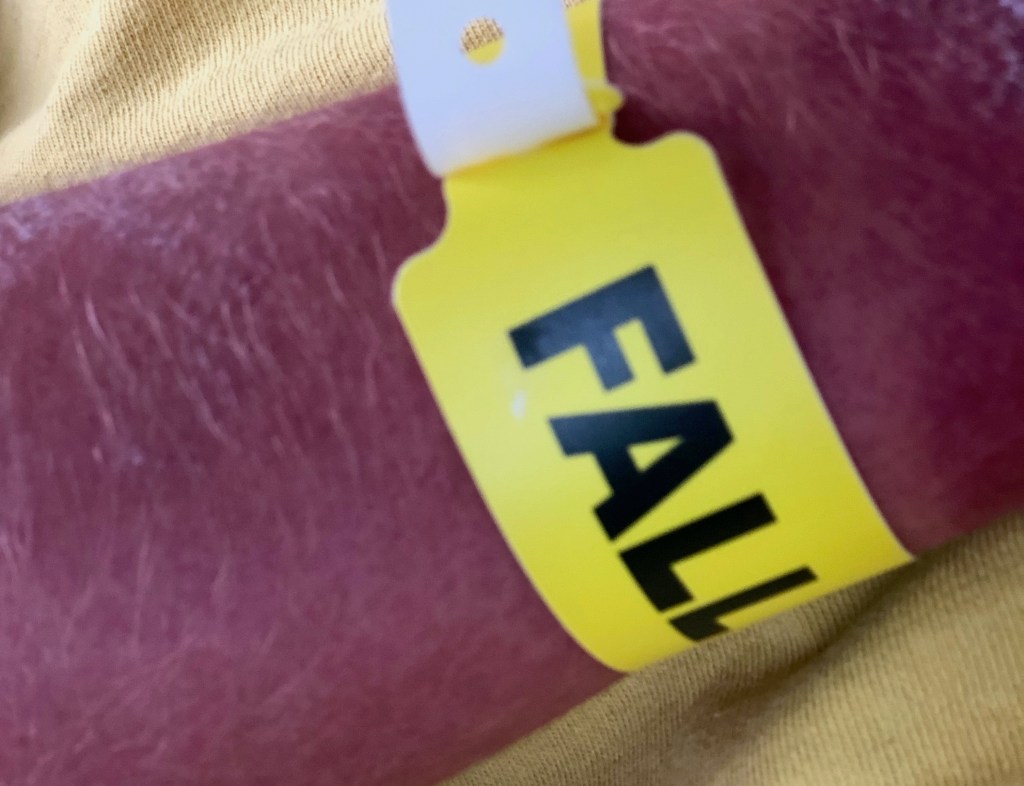
As the days progressed, she appeared to get weaker, was not ingesting any solid food, and it was a struggle to drink. Symptoms included fever, body aches, headaches, dizziness, nausea and vomiting. Additionally, on two occasions, she got out of bed and fell to the ground. Later we realized that she was experiencing such a tremendous drop in her blood pressure when she moved from lying to standing that she was blacking out.
Her very conscientious doctor was in constant contact and requested to see her, to test her blood again and check for dehydration. After five days of unabated fever and no food, she had become so weak she was unable to walk. We had a doctor visit us at home to take blood and give her fluids by IV. Following the blood test result, she was admitted to hospital due to a rapid decline in her platelets.
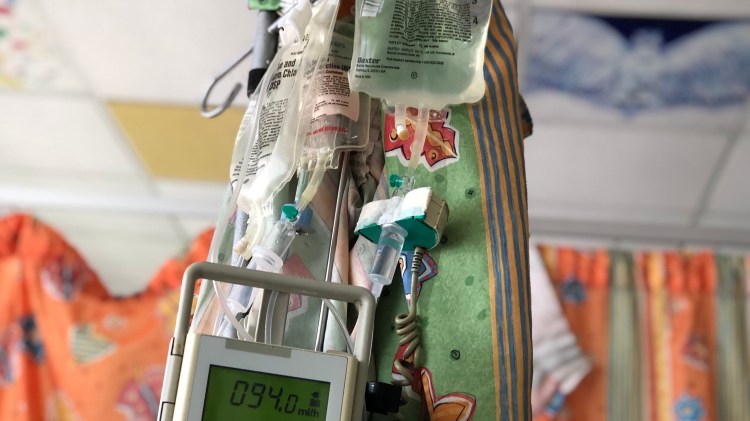
The transition from dengue fever to severe dengue fever. Six surreal days of continuous IV drips, blood pressure checks and blood tests. I learned words like thrombocytopenia and postural hypotension. I watched nervously as my child lay mostly motionless in bed. We were approaching Day 8 of no food by mouth, continually nauseous, lethargic, rarely sitting up and unable to stand due to extreme dizziness (postural hypotension). Her platelet level was tested daily and continued to fall for the first few days (thrombocytopenia) before stabilising.
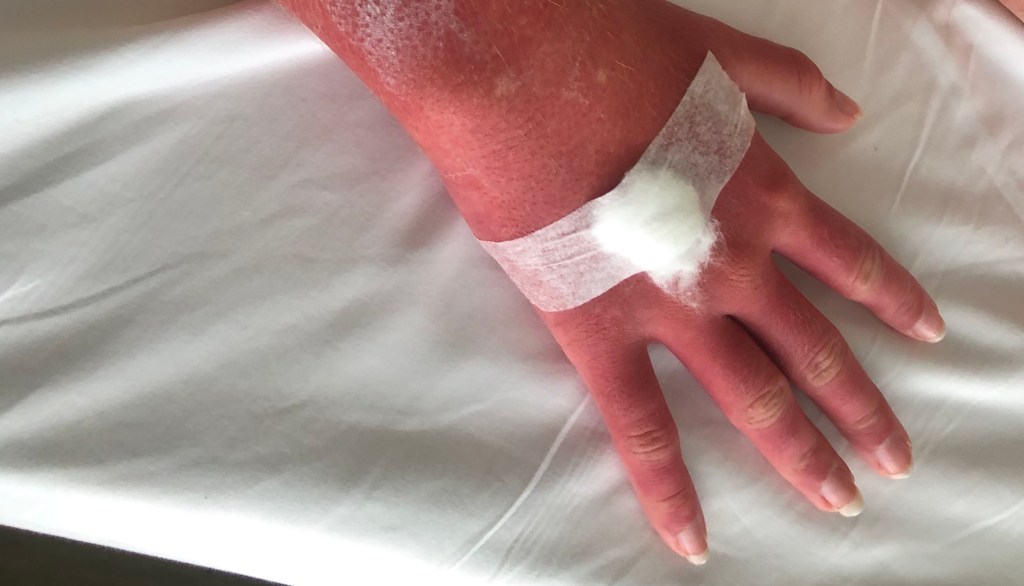
Things were looking up I thought, with platelet decline arrested and a fever reduction. Then the horrendous rash arrived. It seems everyone’s experience with the rash is different; some itch and some do not.
In her case, there was extreme itching. Antihistamines were administered by drip every few hours which helped. We applied calamine lotion, but this provided limited relief. Very weak and very tired, the onslaught of the rash was very challenging. “I feel like I am on fire, can I get more medication,” she kept quietly saying for about 36 hours with some respite at intervals from the antihistamine.
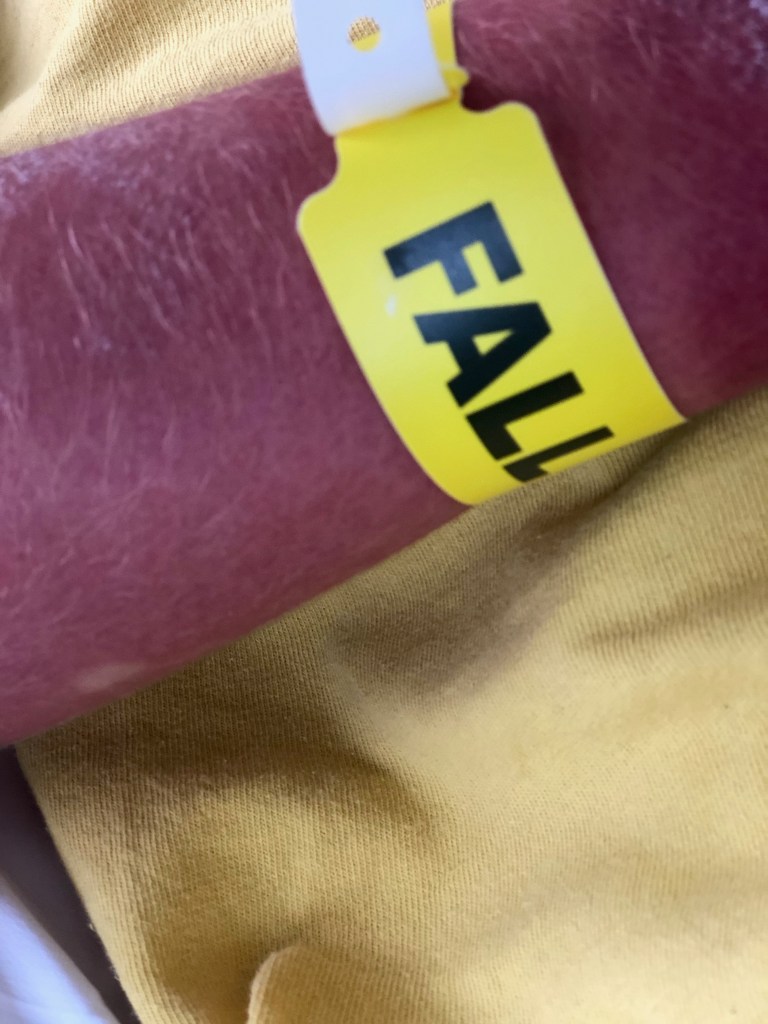
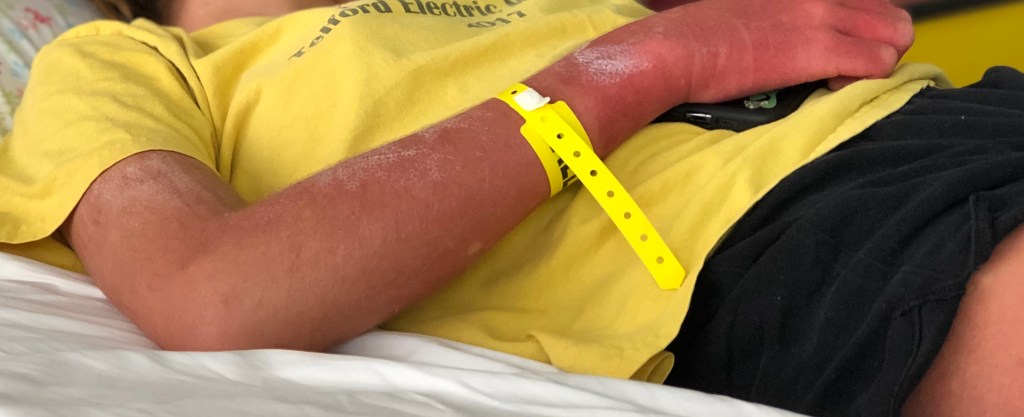
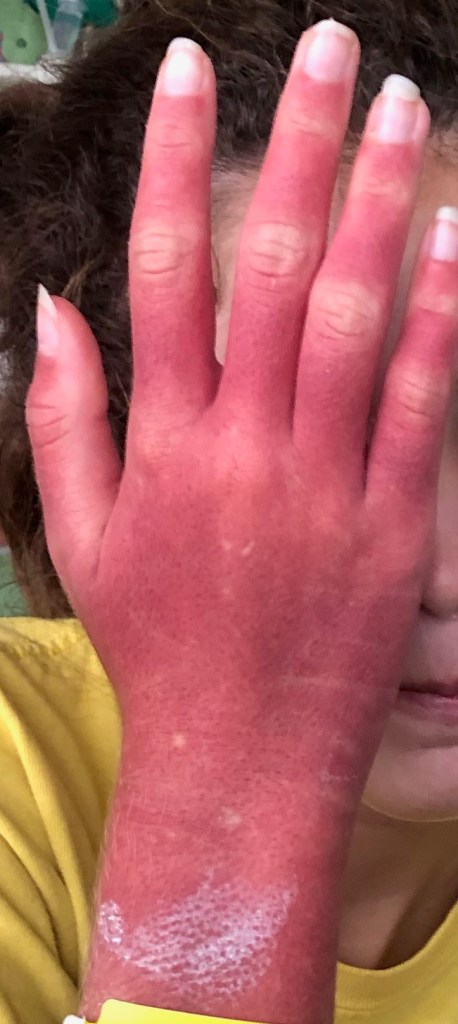
As the itching reduced, however, the rash evolved into an overall redness with only her face remaining her usual colour! One of the doctors said, “Wow, she seems to be experiencing the whole range of possible dengue symptoms.”
The redness was sub-cutaneous bleeding the doctors said, another possible symptom with severe dengue fever. Online articles speak of “plasma leakage” the process by which the fluid of the blood leaks from blood vessels to the surrounding tissue. Expert reports say it’s caused by increased capillary permeability and may manifest in various forms, ranging from petechial skin haemorrhages to life-threatening gastrointestinal bleeding. Thankfully, hers was the former and not the latter. At the same time, as the redness spread everywhere, her feet and hands swelled – fluid accumulation, apparently just completing the checklist of having almost every symptom possible!
And just like that, magically, we turned a corner, and she asked for rice to eat. Another two days passed and then we were homeward bound. It wasn’t just back to life as normal, however. Dengue fever did a number on her. Another week of a lot of sleep before she could go back to school. She was exhausted, and the tiredness continued for another two weeks. Weeks later she still isn’t completely herself.
Dengue may not be avoidable, but, in my opinion, with more effort, we could reduce its incidence. The Government has its fogging routine, and I’ve heard public service announcements on the radio about taking care of allowing standing water on properties.
It’s time for all residents to act responsibly and make sure no mosquitoes are breeding around their homes, within their neighbourhoods and their children’s schools.
This strain seems very harsh on children, there were eight in hospital when we were there. I am confident it may be a terrible experience for the elderly. Given the COVID environment, it’s unlikely everyone is being tested for dengue! I believe there are many more dengue cases than are being reported. Please play your part.
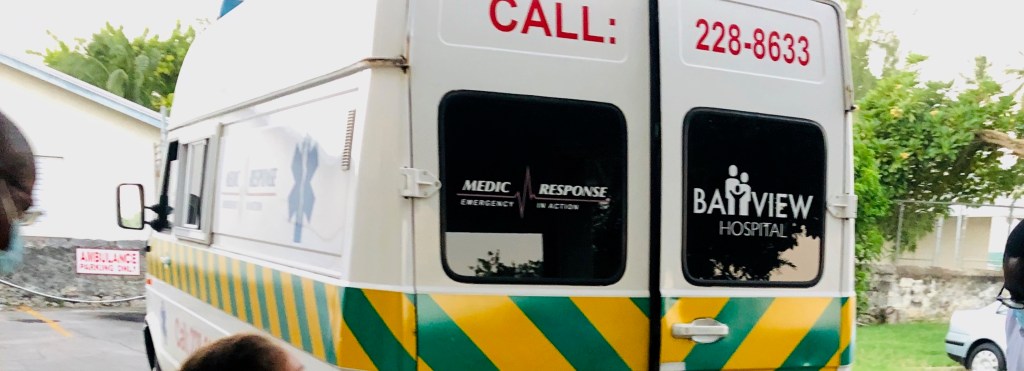
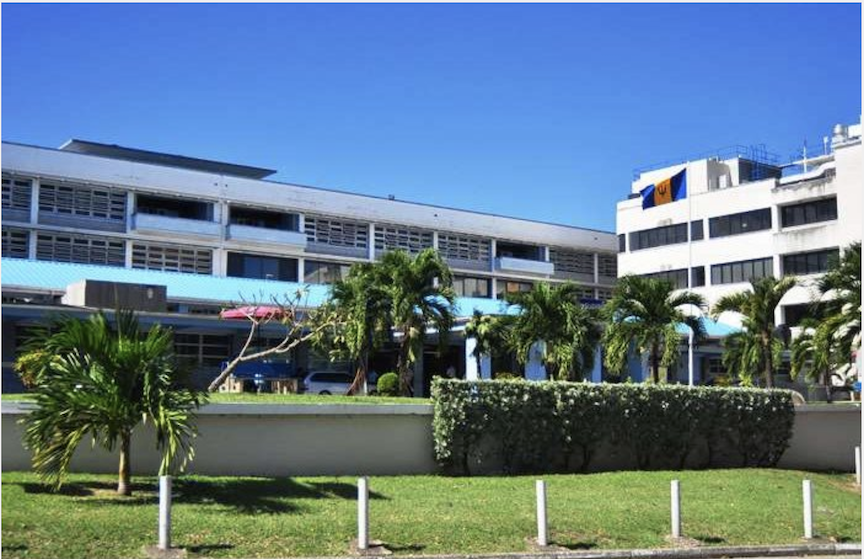
Queen Elizabeth Hospital often gets a bad rap. My daughter received excellent care. I would like to personally thank the very hard-working doctors, residents, interns, nurses and other support staff of the Children’s ward of the QEH. Additionally, a huge thank you to one of the most dedicated paediatricians on the island: Dr Soo Ping Chow. Further thanks to Urgent Care for responding so promptly and the team at Medic Response for a smooth transferral to the QEH Hospital.
Queen Elizabeth Hospital. Picture form Barbados Today news.
* Did you know?
Dengue is common in more than 100 countries around the world.
Forty percent of the world’s population, about 3 billion people, live in areas with a risk of dengue.
Each year, up to 400 million people get infected with dengue.
Dengue is caused by one of any of four related viruses: Dengue virus 1, 2, 3, and 4. For this reason, a person can be infected with a dengue virus as many as four times in his or her lifetime.
(*According to the Centres for Disease Control and Prevention)
It’s exceedingly difficult to capture the essence of an incredible ultra-endurance feat such as the unprecedented Cameron Bellamy Swim from Barbados to St Lucia. It’s an accomplishment beyond most people’s comprehension – how could it be possible to swim through 3 days and 2 nights? Cameron “Cam” Bellamy did it and was watched, every stroke of the way, by an awestruck support crew.
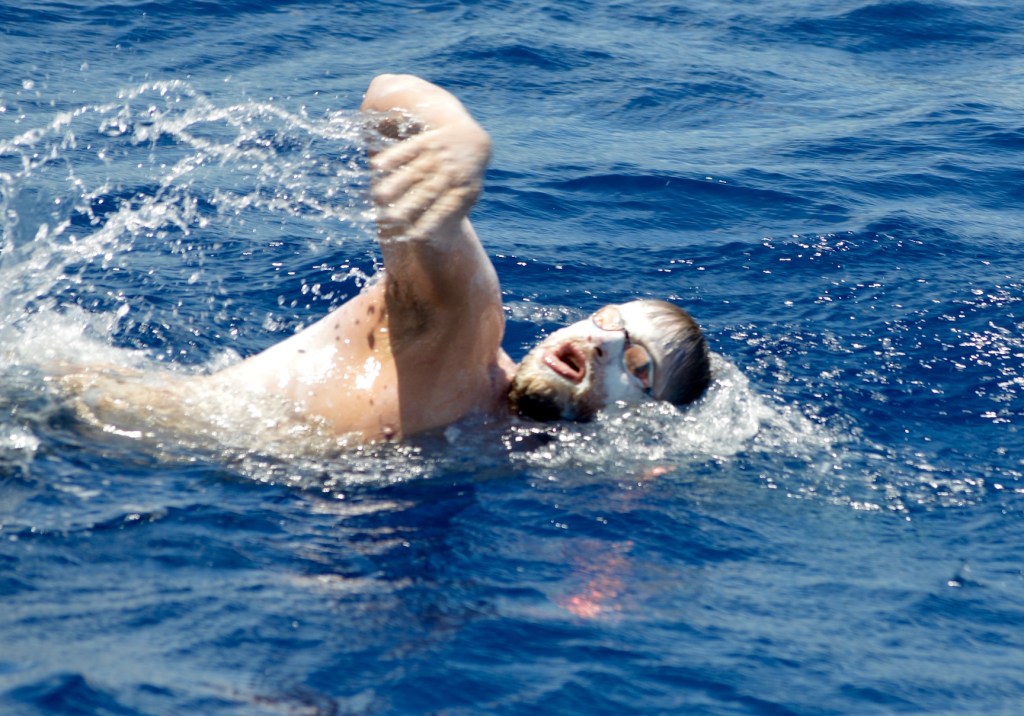
Cam departed from St Peters Bay in Barbados at 8:18 am on Friday September 13 and touched a rocky outcrop in the scenic Moule a Chique area near Vieux Fort at 5:13 pm on Sunday September 15. He swam a distance of 150K. He was in the water for 56 hours and 55 minutes.
He had put in the training, nine months of solid swimming and built on his 2018 foundation when he had trained to swim 90K around Barbados. Over the months in 2019 he increased his training hours to 60 hours of swimming weekly. The water literally became his office.
Of course, in addition to the training there was other planning and preparations that go into an independent solo marathon swim. In this case even more so being that the swim was initially planned for the Florida Straits and then changed to Barbados to St Lucia in the latter part of August. This left only a few weeks to assemble new crew, secure a support boat and boat captain, fulfill all requirements by authorities on both islands, ship in needed items, hire medics and study the currents to ascertain start and finish points among numerous other details. Even when all was planned, unexpected weather caused the departure date to be moved forward by two days, which played havoc with some of the logistics.
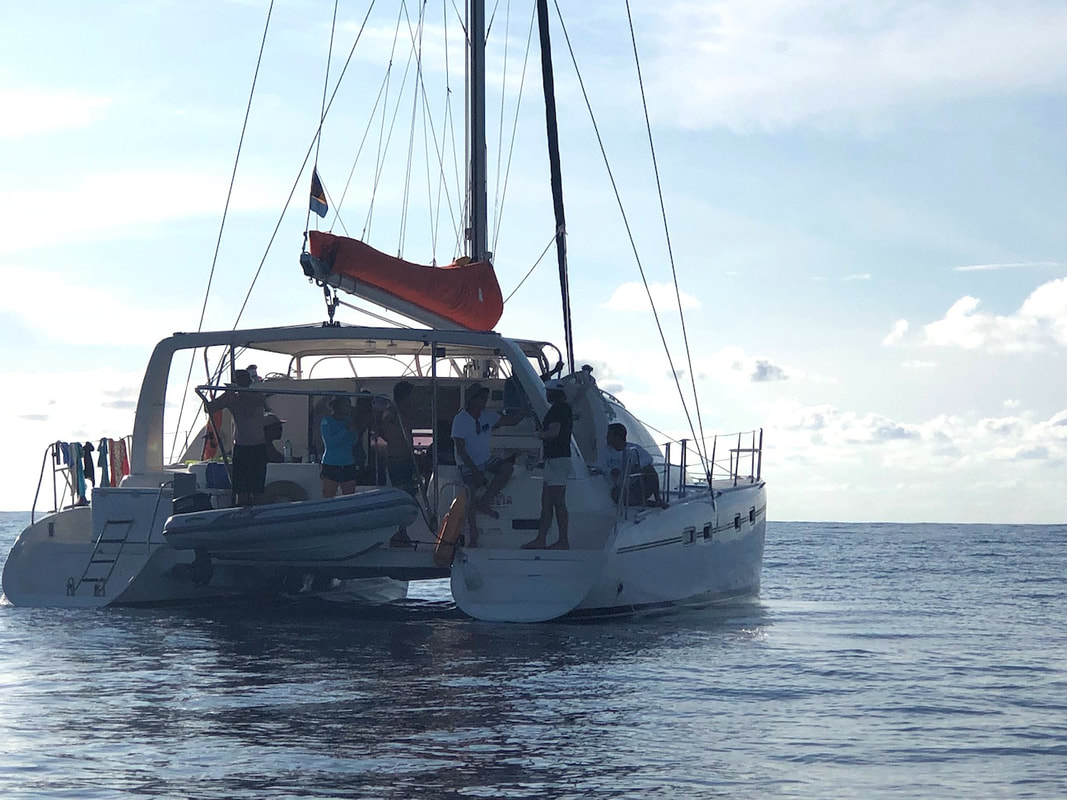
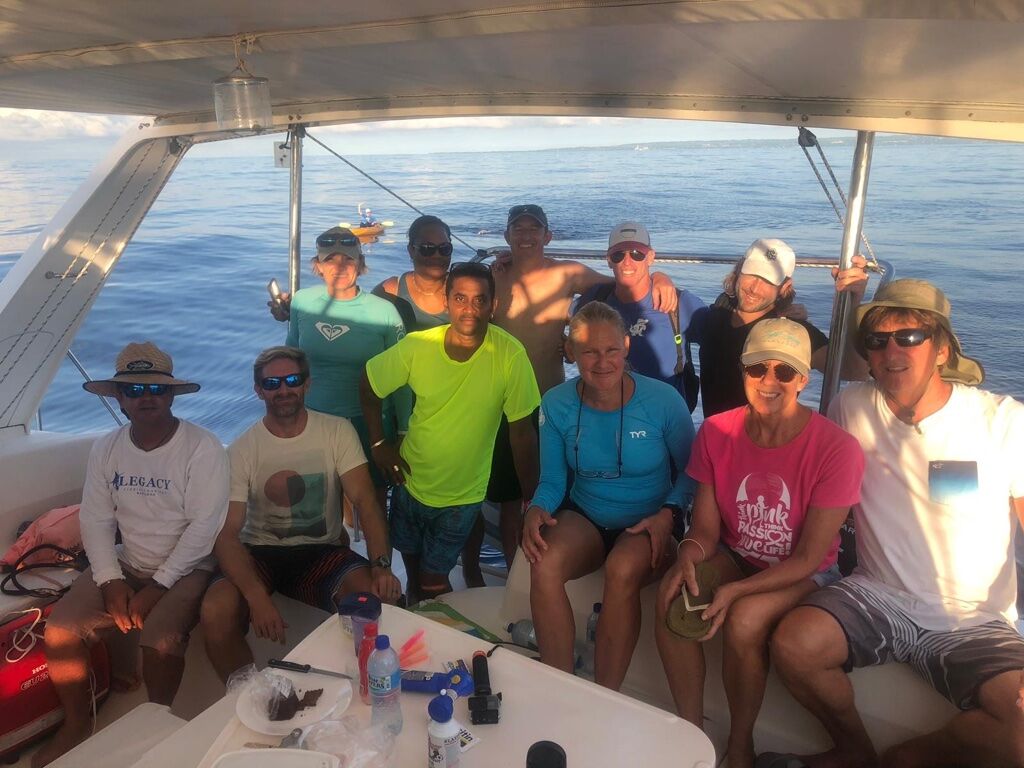
Life on the support boat for three days was a highly unique and a truly unforgettable experience. In some ways it’s difficult to describe after the fact but one factor that is clear is the significant role of support crew in an independent solo swim, especially very long swims such as this. The support boat was aptly named “Imagine”, the perfect name really as the story that unfolded over three days at sea was well beyond our imagination!
Most stories of long swims focus only on the swimmer: their time to complete, their physical condition at the end of the swim, their time, what they drank and ate, their experience, what they did or didn’t think about as they swam but insight into the support crew, their functions and experiences is an integral yet rarely shared part of the tale.
Many ask if it became boring for those sitting on the boat moving at idle speed for three days. Quite the opposite really, because every minute of every hour the swimmer has to be watched from the boat by an Observer, accompanied by at least one kayak, given food and drink every half hour and every other hour a support swimmer is allowed to jump in and swim alongside the swimmer.
The Observer on duty was responsible for keeping the swimmer in their sight, noting wind speeds, latitude and longitude, stroke rate (number of strokes swimmer took per minute), sea/air temperatures and any other notable points, every half hour, for the duration of the swim.
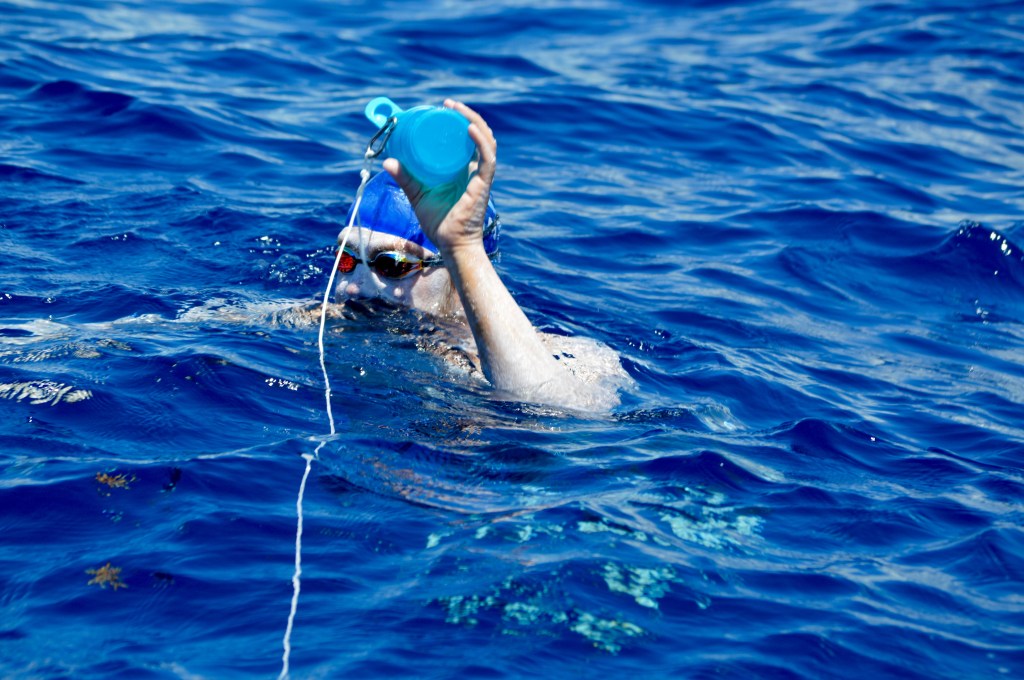
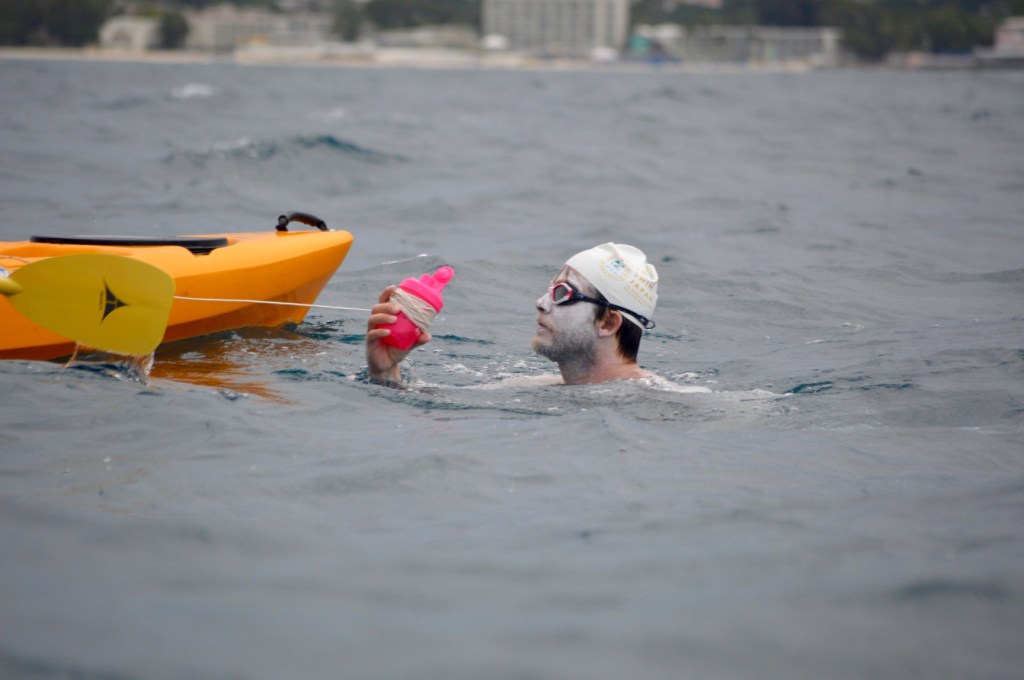
As with all endurance feats the nutrition of the athlete is of utmost importance. Rehydrating as well as replenishing with complex carbohydrates and really just putting back in those burned calories. Even with drinking at least 200 ml every half-hour and eating every hour Cam lost a significant amount of weight during the swim. His diet consisted of chocolate bars, bananas, yogurts, waffles, smoothies, GU gels, nut butters and of course several helpings of good home-cooked Barbadian macaroni pie. For his liquid intake: Carbo Pro & Water mix, Powerade, coke and water. Additionally, Listerine mouthwash was used regularly to keep removing the salt water from his mouth and Vaseline applied to try to protect his mouth, lips and tongue from the effects of salt water. Cam received his food/drink from one of the swim boards at the back of the support catamaran, where he was not allowed to touch the boat but rather came near and treaded water while being handed food or thrown his drink in a closed cup attached to a string. The feeding sessions kept the boat captains busy as every half hour they were required to manoeuvre the boat to a position where he could access the boat while keeping him on his swim route. Luckily the two boat pilots were very experienced and did a stellar job not only with feeding but continually assessing the conditions and tweaking the route to ensure Cam arrived at the planned destination in the south of St Lucia.
The crew took turns with kayaking often in two-hour shifts, day and night, feeding and support swimming as well as documenting the trip with numerous video clips and photos. The crew became tired too, many suffering from sleep deprivation and several with seasickness but everyone was completely focused on Cam and his end goal. Generally, it all went like clockwork and was a shining example of what excellent teamwork can accomplish.
Through it all Cam just kept swimming. On the boat meals were served, people slept in shifts, played backgammon, watched sunsets, made fun of each other, kayaked, observed, enjoyed full moons and beautiful sunrises and still he swam. Eat, drink, swim and repeat every half hour and every hour day and night.
There were a plethora of memorable moments on the boat, too many to recount but a few highlights are likely etched in the memories of the crew for a lifetime.
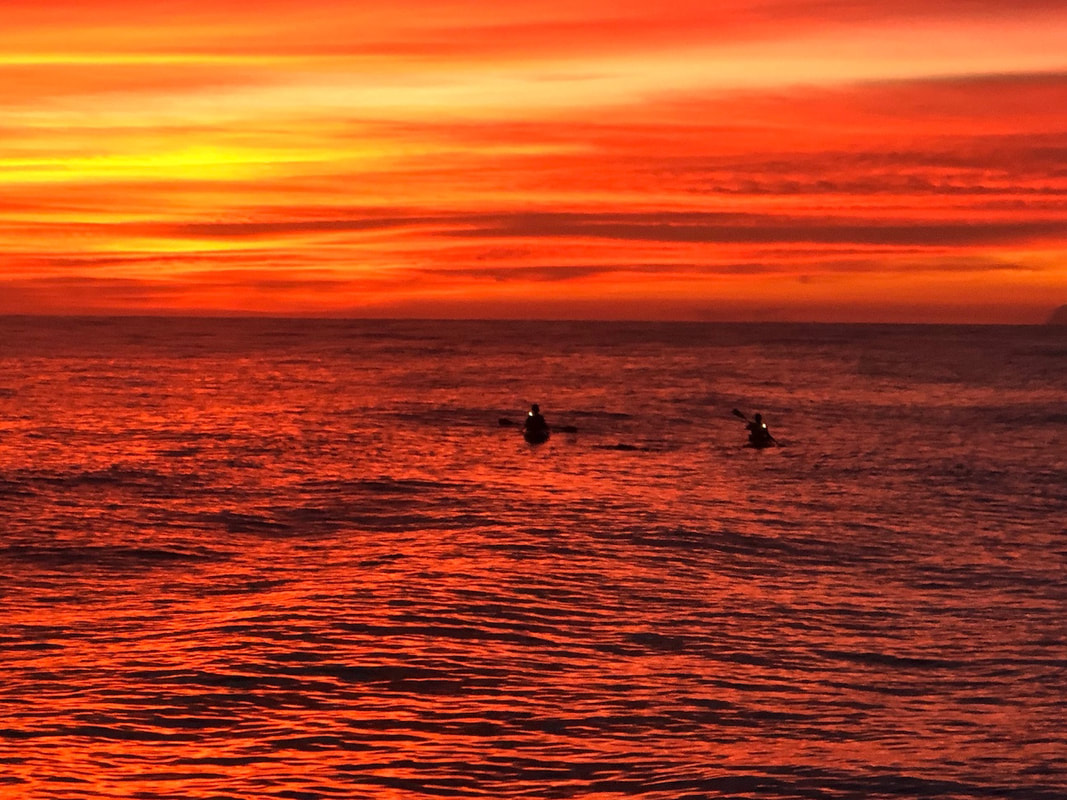
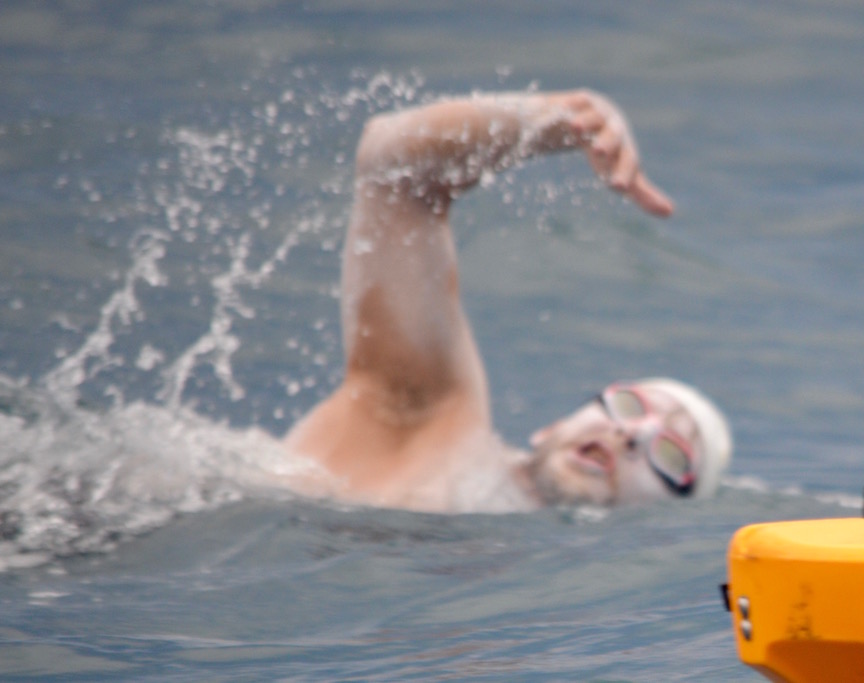
As dusk approached on the first evening the sea became very flat and as the sun disappeared, an enormous moon rose casting a wondrous beam of moonlight across the tranquil ocean. At one point looking back from the boat Cam was caught swimming along in water lit by the moon-beam with two kayakers on either side. It was a remarkable sight. Kayaking that night was surreal. Sitting atop thousands of feet of incredibly still water in the vast open sea; the moonlight was mesmerizing and the setting so serene, just the slap of a swimmer’s arms hitting the water and two kayaks silently gliding on either side.
The days were very warm but the second day was a scorcher with air temps hitting 33 degrees C for several hours. Not unexpected as September is one of the hottest months in the Caribbean. On the second day the air temp was very warm from shortly after sunrise. Cam had been swimming for 24 hours. It was hot in the shade on the boat and on the water the heat was blistering. Even though the water depth was in the thousands of feet the top layer was warm to the touch – like a bath-tub of warm water. The heat caused Cam several hours of visible discomfort and the crew was substantially worried that he may not be able to make it till sundown and cooler temperatures – but he fought through it and plodded on, having extra ice in his drinks and putting ice and cold water on his head.
On that second night when dusk was approaching and the Barbados coastline had faded away a most stunning sunset ensued. Impressive hues of bright reds and oranges filled the sky and their reflection on the water created an illusion almost as if the water was on fire. The crew and Cam were spellbound, sheer beauty all around us and nothing but distant horizons in every direction. Then nightfall came and swimming through the long hours of darkness of a second night in the water.
And just like that the conditions changed on that second night, a squall blew through after nightfall, the sea became choppy, swells started rolling through, the boat began rocking and items flew off all the table tops throughout the boat. Kayaking in the dark that night was somewhat unnerving as the sea was choppy with white caps and small swells moving through perpendicular to our travelling direction.
Sunrise on Sunday was a defining moment – looming in the distance was the outline of the cliffs of the southern tip of St Lucia. When Cam was told St. Lucia was visible he stopped swimming and popped his head up as high as he could and seeing the land on the horizon set out with renewed vigour towards Vieux Fort.
Approaching the southern tip of St Lucia and the planned beach to complete the swim after 55 hours was another extraordinary moment. Cam was directed by the kayakers towards the beach, where a welcome party including his mother and the Prime Minister were patiently waiting, but a strong adverse current was encountered and forward progression was impeded. Even the kayakers were finding it difficult to stay the course. That plan was quickly abandoned and Plan B was hatched: head for the next beach! But the next beach wasn’t even in sight, apparently it was around a headland and probably about 2-3K away.
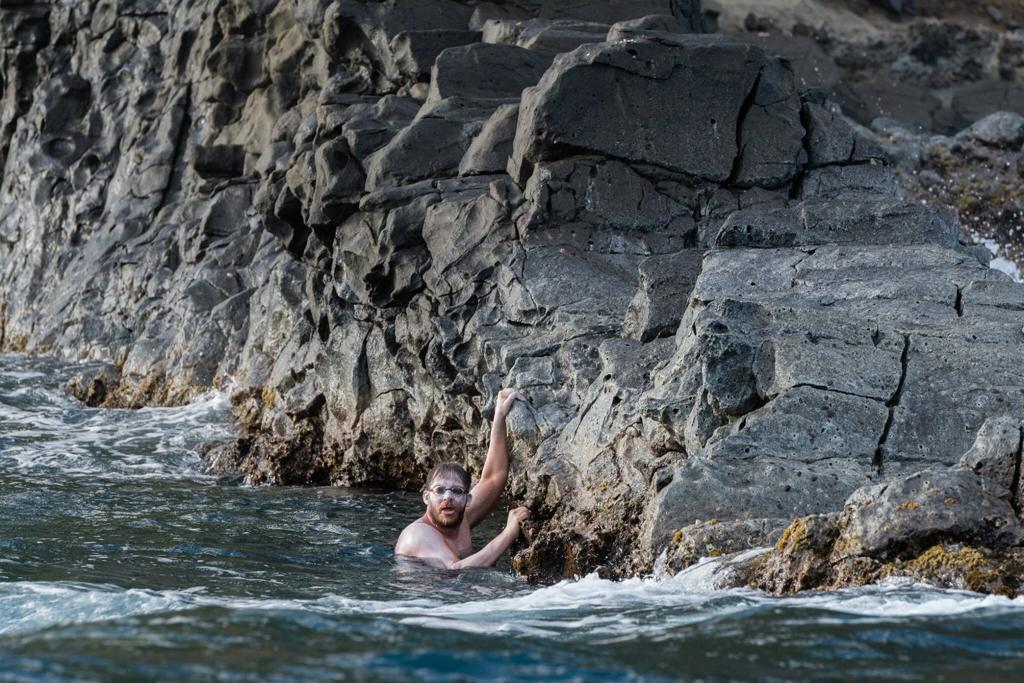
Aligned with Cam and the boats at this point and as far as the eye could see were majestic cliffs rising out of the water and providing a wonderful backdrop for an ending to this epic swim. The decision was made to swim over to the nearest rocky outcrop and “touch St Lucia” to end the swim. Somehow Cam dug deep, even after 56+ hours of swimming and made it to the land.
Cameron Bellamy became the first person ever to swim nonstop from Barbados to St Lucia: 150K in 56 hours and 55 minutes. He survived heat, jellyfish stings, two sleepless nights, sunburn, a horrific case of “salt mouth” which left his lips hugely swollen and cracked, extreme fatigue and very sore shoulders.
It was phenomenal. There are literally no words to adequately describe the exceptional story of Cam’s Caribbean swim. Cam you are an extraordinary human being and your support crew feels privileged to have been able to witness this astounding feat firsthand. Your “out of this world determination”, your dedication to the training required, your humility and your charitable efforts are hugely inspiring.
Kristina what an amazing article, reading it I felt I was on the boat watching the sunset! Great job and cannot imagine the time and energy you put into this event as well as Cam’s other feats here in Barbados. Glad you could share with us.
ReplyRenee Kowlessar9/30/2019 05:37:55 pm
An amazing feat indeed; so happy to be able to read it from the perspective of someone who was there the whole way. Thanks for sharing this Kristina!
ReplyIrving Skinner10/1/2019 07:18:34 am
Extraordinary! Big word, yet not close to describing this feat of strength and endurance. Wonderful written description.
Reply Doris Grannum 10/1/2019 09:54:35 am
This proves that it is not only in wartime that commitment, bravery and co-operation are found. Thanks to the writer of this portrayal of the whole adventure who made it so special for readers. Cameron Bellamy, you deserve a medal!
Replybev10/1/2019 05:37:31 pm
thank you for this beautiful account of this swim. I hope Cam gets lots of money for this remarkable feat.
Reply Di 10/6/2019 07:28:26 am
Well done to all! Take a team to pull anything off.
Cameron Bellamy of South Africa has become the first person in history to complete the highly complex swim around the island of Barbados. His unprecedented swim began on Sunday November 11 at about 11:20 am. Hundreds of swimmers from around the world were already at the Carlisle Bay start as they were taking part in the annual Barbados Open Water Festival. There was an atmosphere of great excitement on the beach as they gathered with many other interested onlookers to cheer him on. Unbelievably, he swam for almost 41 hours and completed the 96K swim at 4:06 am on Tuesday November 13. According to the Marathon Swimming Federation there are only three documented non-stop, unassisted sea swims in history that have been longer than Cameron Bellamy’s incredible swim around Barbados!
The seemingly impossible feat of swimming all the way around the island of Barbados by the South African will be remembered forever by all who witnessed the accomplishment. His is a highly unique and unbelievable story dating back to his first “long swim” across the English Channel in 2012. Swimming this channel, after only one year of swimming, should perhaps have been an indicator of the great moments that would follow in his open water swimming life. In June 2018 Bellamy completed the challenging Oceans Seven swims and joined an elite group of only 11 swimmers to have completed the seven toughest channels. Even before completing the Oceans Seven he already had his sights set on swimming around Barbados and had begun training in earnest.
On September 7, 2018, Bellamy set out on his first attempt to swim around Barbados. He spent 27 hours in the water and swam 66K, from Pebbles Beach on the south west coast to Animal Flower Cave on the north coast via the Atlantic facing East coast. After 24 hours in the water, a shift in the winds and adverse currents off River Bay caused conditions that were exceedingly difficult. He dug deep for another three hours and made it past River Bay to the Cave where he aborted the swim, realising that he still had the “distance of the English Channel” to complete the circumnavigation. Exhausted and with sore shoulders and suffering with a highly painful “salt mouth” he returned to his hotel, admitting that the swim – around the jagged coastline, battling tough conditions on the south east and north coasts including back wash from the cliffs – was more difficult than he expected.
He had put up a great fight and surpassed previous attempts by about 40K. Local swimmers and the community in general were in awe of his attempt even though he hadn’t reached the finish line he had set for himself. However, his tenacious nature was apparent when about 24 hours after the first attempt he announced he would try again. “I am the fittest I have ever been and now I know what I have to do to make it all the way around”. He travelled to Australia, intensified his training and applied a more specific and scientific approach to his training regimen in the waters off the Gold Coast. He swam up to nine hours a day and focused on maintaining a target heart rate among other goals.
Just over 8 weeks after his first attempt Bellamy returned to the island in early November to await a “weather window”: a period of at least two days when the wind and sea conditions would be favourable. Many in the local community were doubtful that November would provide the needed conditions given that the wind speeds are generally higher in this month and sea conditions unpredictable with a much greater probability of “north swells” causing difficult conditions. Swimmers, boaters and surfers all expressed concern that it would be nearly impossible to “get around North point” and the “south-east coast will be too choppy” and the “sea conditions bad”. But Cameron Bellamy pressed on with his plan and with the assistance of various online wind models identified Nov 11-13 as the window to swim.
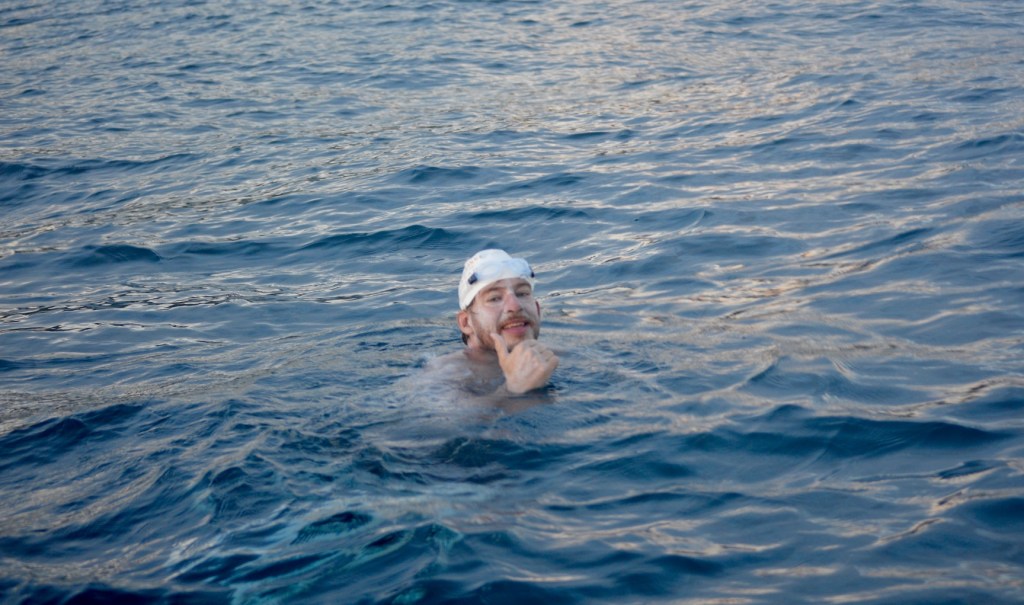
The support crew consisting of about 30 core volunteers acting as kayakers, feeders, observers and boat captains, along with paramedics were assembled. An entourage of eight boats was utilised at different times over “four legs” of the swim. The conditions were not as favourable as the September 2018 attempt and even as he started the swim, on Sunday November 11, a squall passed over the south of the island bringing heavy rainfall, wind and choppy seas. Well, needless to say, Cameron Bellamy, a man who exemplifies the very definition of perseverance, fought through wind and bumpy water on the south, literally ploughed through huge waves in the Kittridge Point/Ragged Point areas of the south-east and continued up the Atlantic facing East coast. When he reached his “nemesis” from the first attempt – the North Coast – conditions were extremely challenging – large swells caused him to detour out to sea to avoid being washed up on the rocky cliffs of the North. Totally focused and maintaining a similar stroke rate throughout he defeated the unforgiving North coast and entered calmer waters on the north west coast of the island. Flagging a bit at this point he had to draw on his steely resolve and the positive energy of his highly supportive crew to keep moving along the west coast. In forty plus hours this was the only point where he said, “I had a few negative thoughts“. Throughout the duration of the swim, he never faltered, taking the time to give a thumbs up and thank-you to volunteers as shifts changed and new support crew took over (pictured below).
News of his success in rounding the North Point spread like wildfire on the island and across the globe where thousands were following his progress by live tracking. Social media exploded with enormous numbers of shares, likes and comments on the posts updating his progress and excitement grew that this time he would make the finish line. Twelve hours later Bellamy swam past the wall of the Deep Water Harbour in the island’s capital city of Bridgetown and swam across Carlisle Bay to his starting point in front of the Copacabana Beach Bar. A large and jubilant crowd, many of whom had tracked him continuously over the two days of his swim, welcomed him as he erupted from the water and walked up the beach.
He had done it. He never let up, he maintained his focus all the way and history has been created. Cameron Bellamy swam around Barbados!
Not sure where to start? One of the really nice things about growing up in a small island like Barbados is the extended family. Everyone has a “Gran” or a “Great Uncle” or “Aunties”, and the elderly are always a wealth of information.
In the old days, pre-1966, Barbados was a low-income economy dependent on sugar, and life was lived very differently by locals. Older relatives remember well that life was hard back then. Money was hard to come by, people lived with a lot less, they saved money for a rainy day and their pastimes were inexpensive.
Photo: Getty Images, The Economist. Cutting Canes near the East Coast of Barbados in the old days.
Well, the time may have come to seek out the advice of this older generation or just learn to live a bit more as they did. This could help us ride out this storm known as the Covid 19 pandemic. It may not be easy, but it is possible!
We Know it’s Overwhelming …. but let’s try not to Panic!
First, let’s recognise that being unemployed or working for a reduced salary can be stressful. Suddenly, many have been faced with a situation where the monthly bills exceed the monthly income being earned. However, with 40, 000+ unemployed in Barbados since the April lockdown, it’s safe to say, you are not alone, many are in the same boat.
“Yes, it can be overwhelming. Yes, the future is uncertain. No, don’t panic. Instead, let’s make a plan.”
Have you been Laid-Off?
Only spend on what you need. Cut out all other expenses if you haven’t already. In the last two decades, Bajans have grown used to more affluent lifestyles. Unfortunately, we didn’t prepare for this crisis. Sometimes we need to re-focus and be clear on what’s important. For example, although we are a fun-loving people, maybe if choosing between a Kadooment Band and an urgently needed new fridge, the latter should win out.
If you have been laid-off or taken a salary cut to think about the questions below:
Do you qualify for unemployment, and are you collecting?
Are you able to pay bills for essentials such as food and electricity?
Have you stopped buying all items that aren’t necessary for survival?
If you are in arrears with providers, have you called them to discuss a way forward?
Have you considered the possibility of other employment if such is available?
Do you have a mortgage? Many banks have offered moratoriums for several months.
What about Land Tax? Ask about a payment plan.
Make a Budget
Never write down your monthly income and expenses? It doesn’t have to be fancy, even a simple budget can help you to see your financial picture more clearly. It will show you how you are really spending your money and how you may be able to save by cutting unnecessary spending.
As said in Forbes recently, “Budgeting can set you free!”. If you already have a budget, now may be the time to re-evaluate that existing budget.
There are many ways to create a budget. There’s the old-time tried and tested way: pen, paper and a calculator. Nowadays, there are budgeting apps if you are tech-savvy or you may like to create the budget in an electronic spreadsheet such as Excel.
Start gathering information. What is your monthly income? What are your expenses? Some expenses are the same every month, some vary every month, and you may need to work out the average monthly cost for those items. The income should be straightforward, but the expenses may take a while to get a handle on if you haven’t previously kept careful track of your spending.
Expenses
Start with your expenses that may be similar every month, see some examples on the checklist below:
Rent
Mortgage
Utilities (electricity, water, TV, Tel, WIFI)
Car loan
Car insurance
School fees
Daycare
Housekeeper
Club or gym memberships
Any other loans
Retirement Savings Plan
Next, try to get a handle on the expenses that may vary from month to month and maybe work out an average over 6 or 12 months.
Groceries
Misc. maintenance/repair of home
House insurance
Medical expenses
Fuel for vehicle
Beware of the Credit Card
What about your credit card payments? What do you use your credit card to purchase?
Do you have an outstanding amount on your credit card? Are you being charged interest due to nonpayment or late payment? Are they recurring fees on your credit card that could be discontinued? Be careful….it is so easy to rack up big bills on your credit card.
Save…. Save…. Save
Buy the essentials and stop spending on everything else for now. Cover your “needs” and take a break on the “wants” for now!
Shop around for services or needed items as deals are available in this pandemic period. Consider cheaper brands when shopping. Reduce expenses such as mobile data – turn it off and only use WIFI. Do you really have to eat out, why not eat in more often?
The expenses that aren’t essential can add up. The clothing and shoes that aren’t really needed but you decide to treat yourself, splurging on that fine dining dinner or spending the day at the spa. Maybe, this isn’t the time for indulgences!
Balance that Budget
The hope is that on completion of the budget, the income covers the expenses! If not, maybe you have to find a way to reduce the costs. Currently leasing a car, perhaps you downsize. What about a “side hustle”, maybe there is a part-time job available on weekends (if you are already working) that could tide you over. Look around your home, sometimes your junk may be another man’s treasure, maybe unused items can be sold. There are pages on Facebook to facilitate this as well as a handy second-hand store.
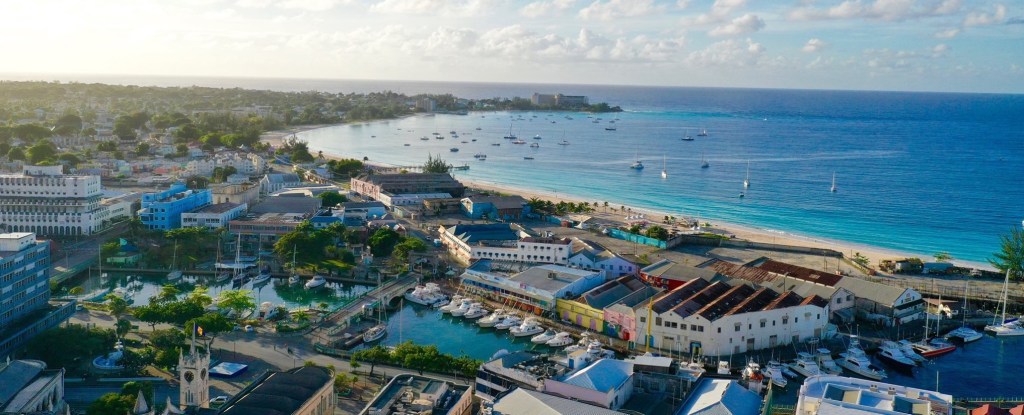
Photo: Caribbean Aerial Photography – Carlisle Bay and Bridgetown
Think of the cheaper alternatives. Maybe you could go for a walk on the boardwalk, pay a visit to Farley Hill Park, lime on any of the many beaches, visit friends and family at their home or catch a movie at the Drive-In. Try an active pastime like a snorkel in Carlisle Bay, exploring the north of the island or go hiking on the east coast, to name a few. There are so many options.
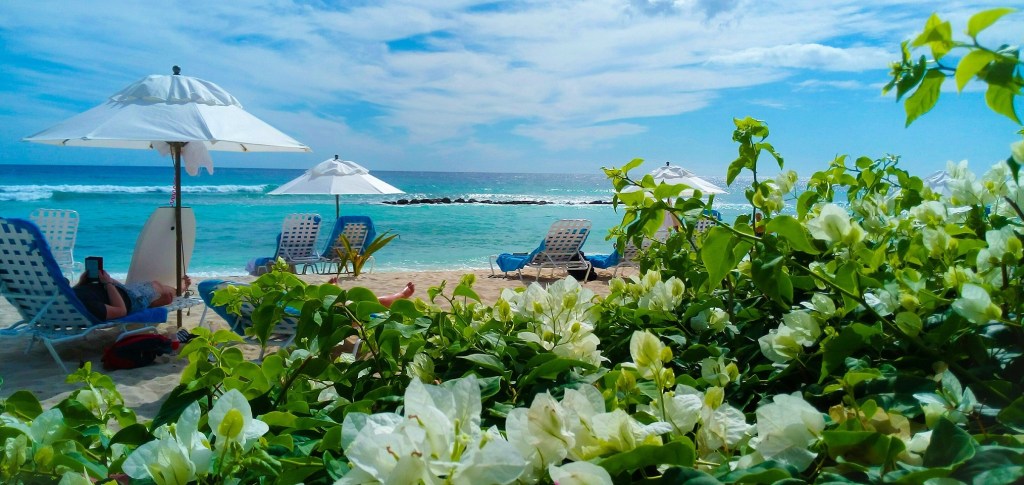
Air travel just got even more difficult! Luckily for us, we have some of the finest resorts in the world. Instead of the expensive trip to New York, London or Toronto, take some time to staycation and enjoy Barbados.
Photo: Sugar Bay Barbados Resort
Lesson Learned
Always have an emergency fund. When the current crisis is over, try to add a monthly contribution to your emergency fund. Maybe even open a separate bank account into which you can deposit funds for use when the next time disaster strikes.
The End Result
Try to see the positive takeaways from this odd year. We learned to live differently – maybe we were too wasteful before. Some of us became more self-sufficient by learning to cook better, growing our own vegetables or completing that long-planned DIY project.
Maybe it took a pandemic for many of us to pay more attention to the important topic that is our finances. Now that you have taken this step, why not continue to monitor the finances? Evaluate and tweak the budget every now and then.
Many are in a challenging financial situation. We will get through this. Chin up! As the old people say,
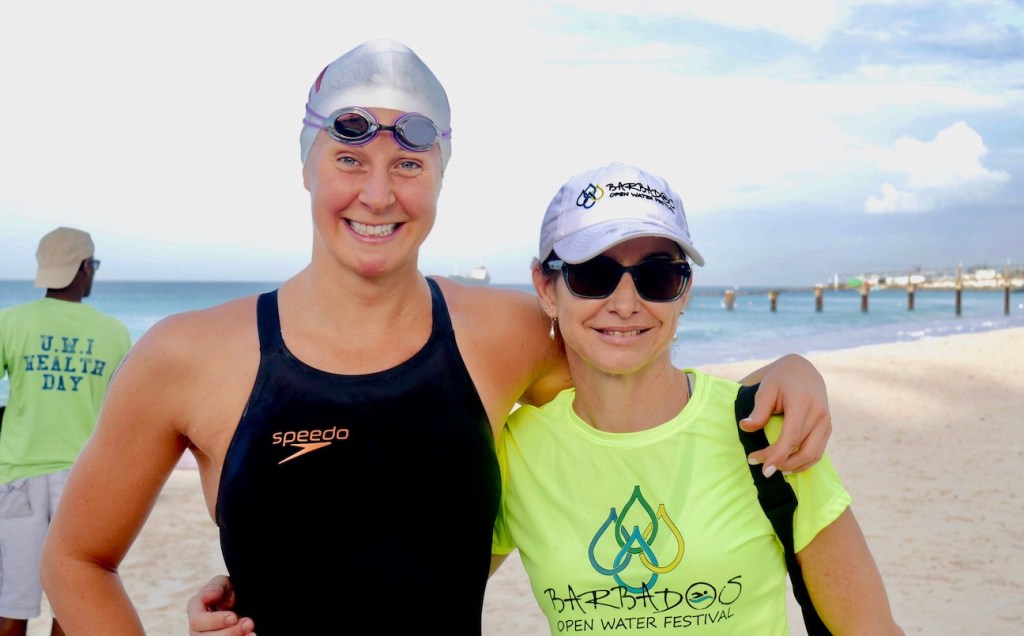
Three time Olympian Steph Horner with Festival Organizer, Kristina Evelyn, at the 2019 Barbados Open Water Festival
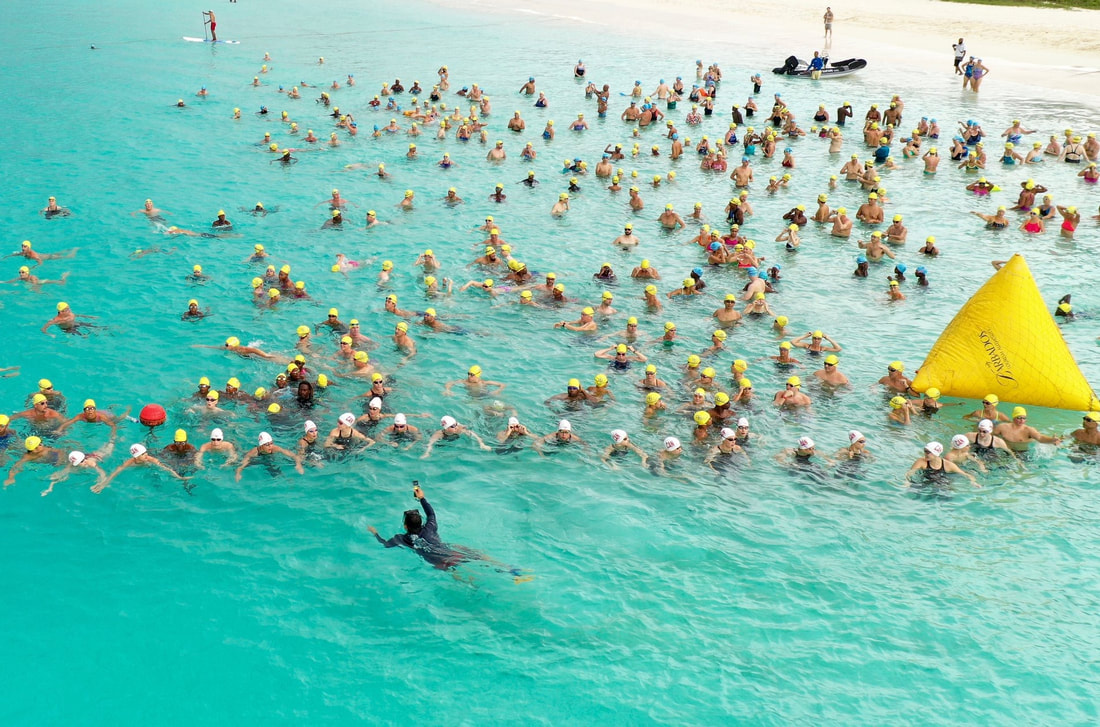
When the curtain came down on the eighth Barbados Open Water Festival last weekend it was the Canadians who had claimed the lion share of medals in the four races. Stephanie Horner, a Pan Am Medalist and three-time Olympian was victorious in both the 1.5K race and the 10K race. Horner, the first Canadian female to win an Open Water World Cup event, hopes to qualify for the 2020 Tokyo Olympics. If successful Horner will become the first Canadian to swim at four Olympic Games. The 8thBarbados Open Water Festival kicked off Nov 6 with about 150 swimmers at practice swims at various venues. The races and charity swim started Nov 9 with the 1.5K race. The first race day was overcast with thick black clouds looming and news of a severe thunderstorm only 20 miles away in the north of the island. Luckily at Carlisle Bay the race continued albeit through a torrential downpour which began as soon as the horn sounded for the start of the race. Thunder was audible in the distance as the three hundred and ninety five swimmers crossed the finish line. The following day the sun came out and an absolutely gorgeous day ensued with excellent conditions for the three hundred plus swimmers in the three Sunday races (3.3K, 5K, 10K).
In addition to Horner attending, a large group of young competitive open water swimmers hailing from all over Canada, led by Mark Perry, Canadian National Open Water Coach, were present at the Festival. Days ahead of the event the talented young swimmers could be seen training at the local Aquatic Centre and in the magnificent Bay, their red and white Canadian swim caps always highly visible. The Perry group had many successes in the races entered (1.5, 5 &10K races): Eric Brown won the 1.5K, Catherine Minic the 5K and Drew Edwards was the winner of the 10K marathon swim. Several others from the group earned second and third place finishes. Ashley Hogg of the UK was able to break through the Canadian domination in the Men’s 5K and grab that title from the Canadian group.
Barbados was well represented in all of the races with a one-two finish in the 3.3K and several age group placings in all races. Adara Stoddard and Toni Walrond of Barbados brought it home with first and second place finishes in the 3.3K. Canadian Zack Hebert-Jarema was the male winner in that race.
The hundreds of recreational swimmers that attended from around the world were thrilled with the presence of two marathon-swimming legends Cameron Bellamy and Jaimie Monahan. Both are more comfortable with much longer swims but enjoyed jumping in and trying the shorter races much to the delight of other competitors. Many wrote on social media about swimming with the two well known swimmers – such as this comment on Cameron Bellamy’s page: “It really was an honour and a memory I’ll cherish to have been able to swim alongside you. Continue to inspire.”
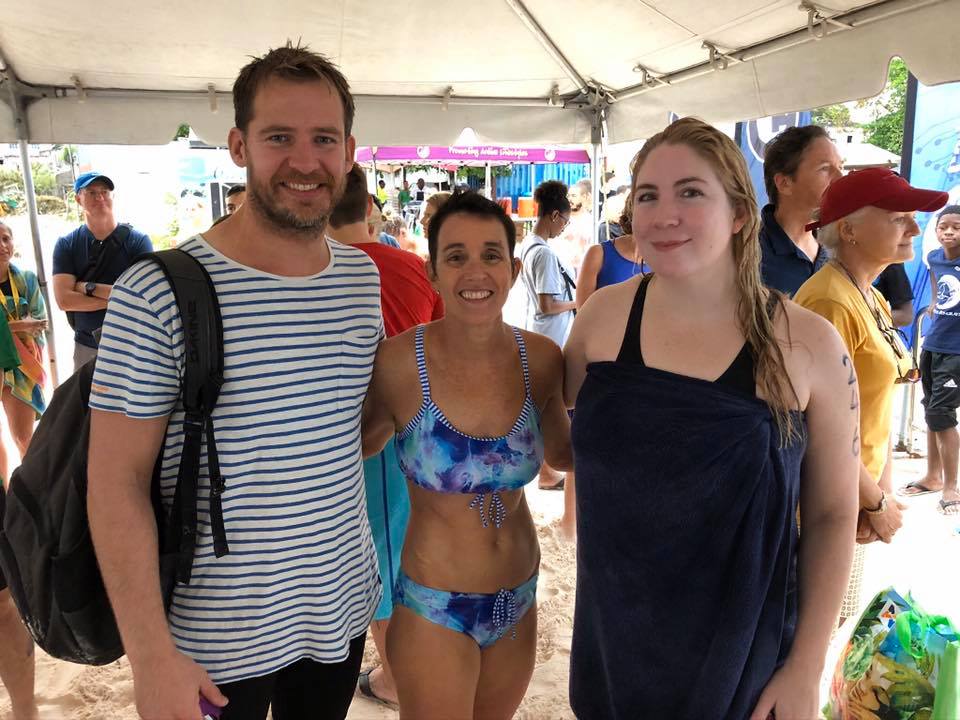
Cameron Bellamy with Beth Schiller and Jaimie Monahan
It’s been a landmark year for open water swimming in Barbados. The Barbados Aquatic Sports Association (BASA) successfully hosted two major regional meets both with open water swimming races, a local charity took to the sea to raise funds through a well subscribed open water relay race and most recently a local and traditionally “pool swimmers club” for juniors hosted a highly popular open water meet.
In the midst of all this, endurance athlete extraordinaire Cameron Bellamy used the island’s waters as his training ground throughout the year and then swam an unprecedented 151K from Barbados to St Lucia in September to complete the longest channel swim ever.
The Barbados Open Water Festival hosted passionate open water swimmers from around the globe and was the finale for what just may be the most outstanding year of open water swimming in the island’s history. Looking forward the future seems bright with this year’s momentum and the growing number of young open water swimmers on the island. The 1.5K race at the Festival boasted 31 swimmers in the under 12 age group and many other young swimmers took part in the Fun Swim.











 Kristina Evelyn